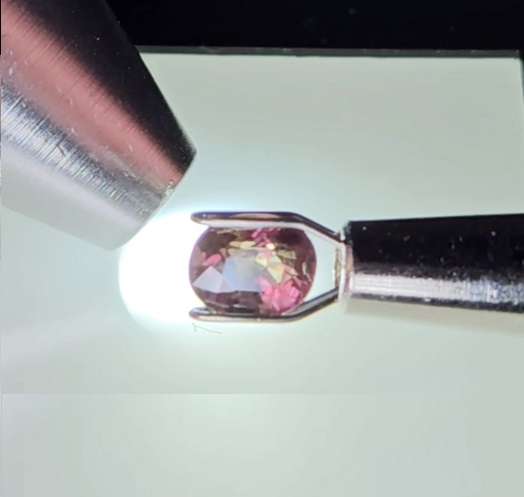
The “Usambara Effect” is an interesting and very beautiful form of colour change and is found in only a few types of gemstones.
It is named after the Usambara mountains in the Umba valley of Tanzania, a region where many of the gemstones that display this effect have been found. Since then other gemstones displaying the Usambara Effect have been found in the Taita-Taveta district in Kenya and also in Madagascar.
The Usambara effect has been found to occur in some gemstones that include: Chromium bearing Tourmalines and Garnets, Corundum, Epidote and Kornerupine.
When we talk about colour change gemstones we look at the difference in colour seen when viewing the gemstone in outside sunlight or when using a daylight equivalent “Cool” white light source and then compare that colour to the colour seen when viewed with a “warm” incandescent light source to identify a change in colour in the gemstone.
With the Usambara Effect, the change in colour in the gemstone is seen by just using a “cool” white light source or outside sunlight, and will usually display as blotchy red patches on the outer areas of the gemstone.
The Usambara effect describes the property of a material to change colour in relation to the path length that the light travels through the material. The perceived colour of the transmitted light shifts from (dark) green to (dark) red.
In the case of Usambara Effect occurring in a Chrome Green Tourmaline, the colour green occurs at the shortest path length from the transmitted light source, while the red colour occurs at the longer path length of reflected light.
The visual effect of this is very beautiful, as these blotchy red patches blend within the gemstones underlying base colour creating a visually striking effect of two separate colours displayed within the gemstone, adding to the gemstones beauty and uniqueness.
Chrome Green Tourmalines are also well known for glowing red under Long wave UV Light and when viewed through a Chelsea filter, as a result of the high chromium content found in this gemstone.
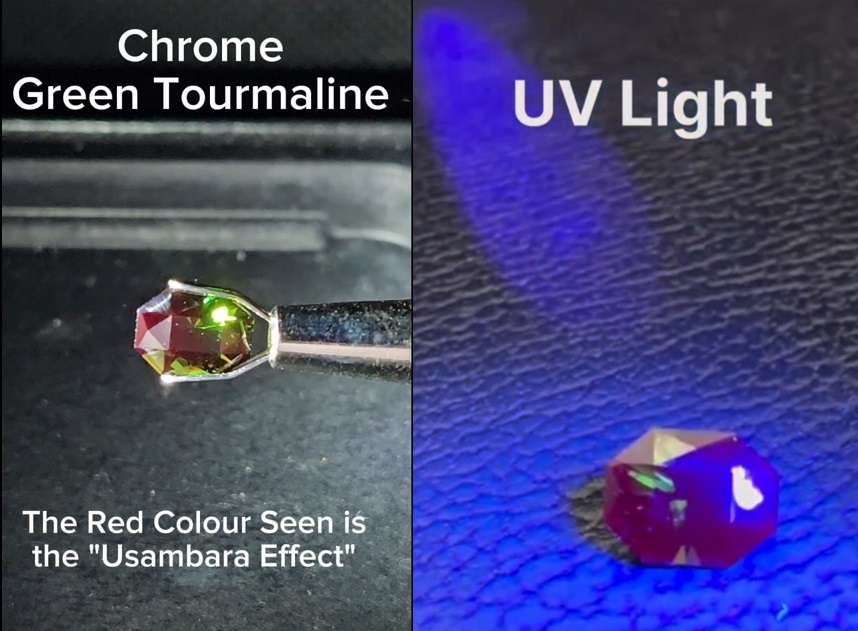
The Usambara Effect can also be seen in some colour change Garnets, which really adds another level of collectability to these gemstones.
Before the name “Usambara Effect”, was given as a name for this phenomenon when seen in these colour change Garnets, early gem dealers often referred to this effect, particularly when seen in colour change Garnets, as dichroism and talked about dichroism occurring in these types of Garnets.
Garnets are of course singly refractive and don’t display dichroism at all, but this was the closet way these gem dealers were able to describe the colours they were seeing in these Garnets.
At first glance Usambara Effect colour change Garnets do indeed appear to display a form of Pleochroism, in the way it will change colours when rotated and viewed at different angles.
Note the overall blotchy reddish colour on the outer facet edges on crown the side of the gemstone when compared to underlying base colour of the gemstone and the lack of red colour on the pavilion side of the gemstone when its rotated, this is an effect that is very similar to what is commonly seen in doubly refractive gemstones like Sapphires.
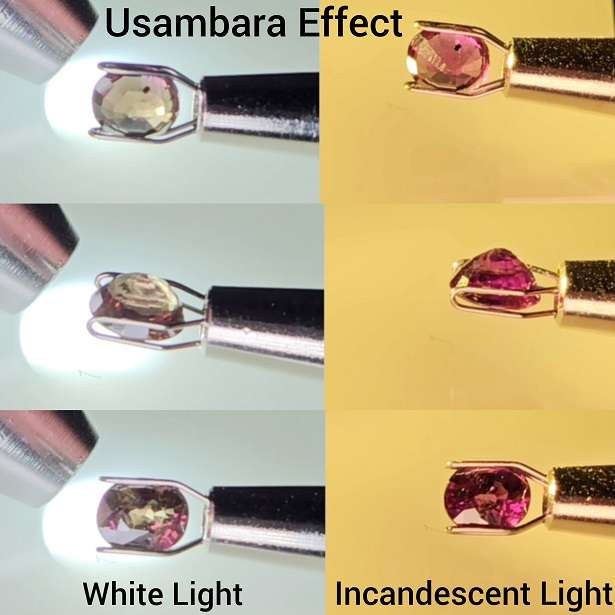
The Usambara Effect, which is seen as blotchy red areas on the outer edges of the gemstone is created because of “doubled” path lengths of light being produced by internal reflections within the gemstone creating the blotchy red “Usambara Effect” areas within the gemstone.
But another point of interest is when it comes to colour change in gemstones worth discussing here, is “warm” incandescent light typically produces “warm colours” like “red”, Pink or purple within the gemstone, while “cool” white light will normally produce “cool colours” like blue or green within a colour change gemstones.
But in the case of Usambara effect gemstones, what should be of extreme interest to collectors, is the “warm colour red”, that you are seeing is being produced from the “cool” white light being doubly reflected within the gemstone.
So this blotchy “warm red” colour being displayed in the gemstone is being produced from “cool” white light making it a very rare example of “reverse” colour change, in that it is displaying a warm red colour from a cool white light source, which is the complete reverse of what colour change gemstones would normally display!
Another important point that then confirms that the gemstone is also a colour change Garnet, is what happens when this Garnet is exposed to a warm incandescent light source.
The underlying base colour then changes to an overall and very saturated red body colour when the gemstone is rotated, due to the colour change effect seen in the Garnet.
So while the Usambara effect is not something commonly seen in gemstones, they create a very beautiful visual effect within a gemstone making them sought after and highly appreciated by gem collectors, connoisseurs and gemologists alike.
I have personally been fascinated with colour change gemstones for many years and have devoted a lot of my time researching this topic and developing simple ways to identify them.
So as you can imagine I became a bit of a collector these gemstones myself and I usually have a good variety of them available on the Gemrock Investments website should you wish to consider any of them for your own collection.
You can review our list of current gemstones on offer here:
General Disclaimer:
Any information provided by Gemrock Investments is for informational purposes only, and does not constitute financial advice, either general or specific. You should assess whether the information is appropriate to your individual financial circumstances before making an investment decision.
Gemrock Investments are not financial advisors. You should always seek professional financial advice from your accountant or financial planner before making major financial decisions.
The information provided has been derived from research and sources believed to be reliable. However, no guarantee is expressed or implied as to their validity. Opinions included herein are subject to change without notice.
All investments involve different degrees of risk and you should be aware of your risk tolerance level and your financial situation at all times.
The gem market is speculative and unregulated and certification does not eliminate all risks associated with the grading of gems.
It is also important to remember that previous growth and returns demonstrated from gemstone investments are not an indicator of future growth nor is it intended as an offer or solicitation with respect to the purchase or sale of any security or gemstone.
Gemrock Investments may also own gemstones in areas they feature or discuss.
Gemrock Investments urges you to obtain professional advice before proceeding with any gemstone investment decision.
