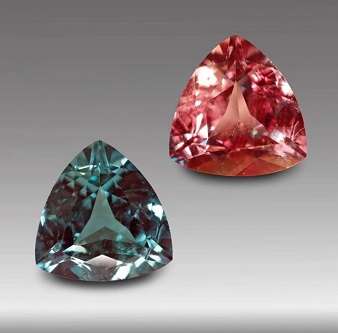
Colour change gemstones are in my opinion the ultimate form of collectable gemstone.
When you think of other “collectables” out there like stamps and rare coins, there are many comparisons we could draw on with colour change gemstones.
“Rarity“ is one comparison colour change gemstones certainly share with the rarity aspect of stamp and coin collecting, along with the uniqueness of their design.
There are only a small percentage of gemstones that will display the colour change effect E.g. different colours under different light conditions, which gives them a greater appeal and rarity over many of the single coloured gemstones available out there.
Apart from that, another aspect that make them collectable is the variety of different colour change combinations you can find in them and collect.
Of particular interest for a collector is the different changes in colour that can occur in the same gemstone family group like Zircon that also share the same underlying base colour like Maroon purple mauve, but will then show completely different changes in colour when exposed to a warm incandescent light source.
So while one Zircon with an underlying base colour of Maroon purple mauve might change to a reasonably common raspberry red colour under an incandescent light source another might change to a much rarer Madeira orange colour, while another might change colour to pink.
It’s the differences in these colour change combinations and even more importantly the rarity of the colour it actually changes to, that make colour change gemstones very collectable indeed!
The history that surrounds the colour change gemstones phenomena, begins with the discovery Alexandrite in Russia, back in 1830.
Alexandrite is famous for displaying its green and red colour shades under different light conditions, and is said to represent an Emerald by day and a Ruby by night.
Alexandrite is still the world’s most sought after and famous colour change gemstone and remains at the top of the list for collectors of colour change gemstones.
Even today colour change gemstones are often referred to as having the “Alexandrite effect”.
Since then a number of other gemstones have proven themselves to display the colour change effect, these include gemstones like: Garnet, Tourmaline, Zircon, Spinel, Diaspore and Sapphire.
So while I have listed Sapphire as an example of gemstone that displays colour change, it’s important to remember that only a very small percentage of these gemstones will actually display true colour change.
So What is Colour Change?
Colour change occurs when a gemstone appears one colour under a light source like natural daylight and then a completely different colour when viewed with another light source like candlelight or incandescent light.
The first step is to determine the underlying base colour of the gemstone, this is usually done by viewing the gemstone in outside daylight or by using a daylight equivalent white light source.
These days the standard method for detecting colour change in colour change gemstones is to simply compare the difference between what you see in natural light such as outside daylight and other light sources.
In the majority of cases the colour change will be seen using an incandescent light source, but it may also be another light source that will produce the colour change in the gemstone.
Within each gemstone is a combination of “sub” colours that make up its primary underlying base colour.
With colour change gemstones, using different calibrated light temperatures has the effect of isolating one of the “sub” colours that are in the stones overall base colour, which then has the effect of allowing that “sub” colour to become the dominant colour of the gemstone while it is being illuminated with that calibrated light source.
To see an example of this, these Tourmaline crystals have an underlying base colour of blue and pink, but when they are exposed to an incandescent light source, notice how I am able to isolate a small section of each of the Tourmaline crystals underlying base colour and display a greenish yellow colour from the blue Tourmaline crystal and orange from the pink Tourmaline crystal, giving them a bi-coloured Tourmaline look, just by shining a focused incandescent light source on them!
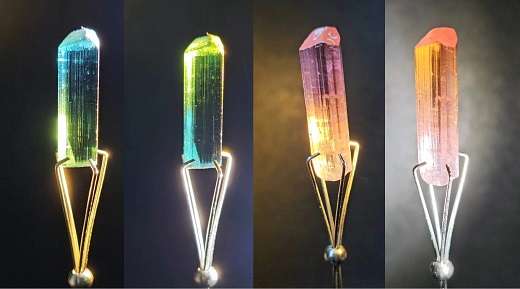
The science behind this colour change effect is the underlying “sub” colours that are a part of the stones primary base colour are being isolated with our calibrated light temperatures, so when a colour change gemstone is exposed to different light temperatures, they will appear different colours under different light sources.
So a Maroon mauve coloured Zircon might appear purple under cool white light source and Red when exposed to warm incandescent yellow light source and often outside sunshine or a daylight equivalent light source will even produce another colour when viewing the gemstone.
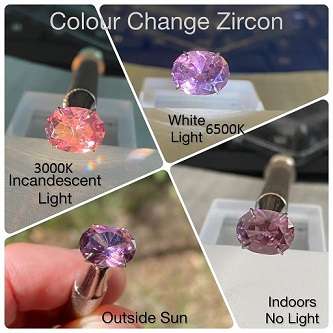
The various shades of colours these colour change gemstones can display can be quite varied in each type of gemstone, which is another element that makes these gemstones collectable.
You could collect a number of different colour change gemstone that may have the same underlying base colour, but display a completely different combination of colours when exposed to the same coloured light sources!
As an example of this, notice these two Zircons display the same underling base colour of Maroon Mauve, but when exposed to a warm incandescent light source, one Zircon turns a raspberry red colour while other Zircon turns a much rarer Madeira orange colour.
So while both these gemstones are Zircons and have the same underlying base colour of Maroon Mauve, they each display completely different colours when exposed to a warm incandescent light source!
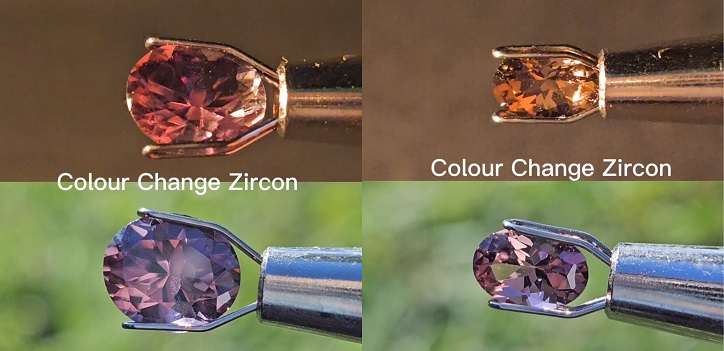
As your knowledge of colour change grows you will find some combinations of colours are more valuable then others.
For instance, it is reasonable common to find purple to red colour change combinations in Garnets but rarer to find pink to red colour change Garnets and even rarer again to find blue to red colour change Garnets.
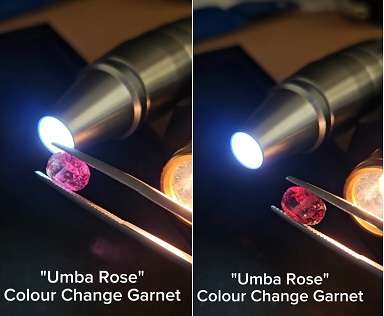
Another big consideration with colour change gemstones is the degree of colour change strength they can display, with the rarest variety’s showing the strongest degree of colour change and the more common varieties showing a weaker change in colour often referred to as “colour shift”.
To determine colour change strength in gemstones, colour change models are used in conjunction with a twelve pointed colour wheel to measure the degree of colour change strength seen in these gemstones.
You can read a detailed article about measuring the strength of colour change gemstones here:
So What’s Not Colour Change?
Some gemstones are naturally pleochroic like Sapphires, meaning they naturally display one colour under white light when viewed on one axis of the gemstone – like blue, and then a completely different colour – like green, when you rotate the gemstone and view it at different angle on another axis of the gemstone.
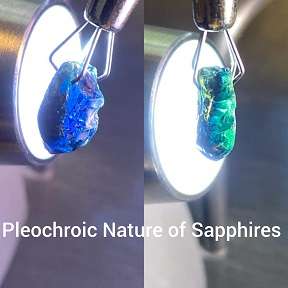
If a Sapphire was truly displaying colour change, you could rotate the stone around viewing it on all axis’s of the gemstone while exposing it to white light and it will remain the same colour – like green.
It will then change and stay a different colour – like yellow, while being rotated around and exposed to another light temperature like warm incandescent light.
Another point of confusion with colour change gemstones is UV reactive gemstones.
Some people will show you a gemstone and expose it to purple UV light, the gemstone will usually then glow red or orange and they will say it’s showing colour change.
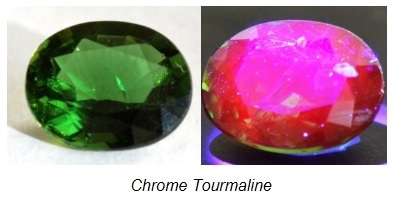
This is not what we refer to as colour change, it is simply displaying another attractive feature some gemstones display, which tells you its UV reactive, but not a colour change gemstone.
You can usually tell this is the case when you see it, as the light the gemstone is being exposed to will be purple in colour.
Its worth pointing out that some colour change gemstones will also be UV reactive, this would make them very rare as they would display both the colour change effect and are UV reactive, which makes it worth checking them for this.
I have personally been fascinated with colour change gemstones for many years and have devoted a lot of my time researching this topic and developing simple ways to identify them.
So as you can imagine I became a bit of a collector these gemstones myself and I usually have a good variety of them available on the Gemrock Investments website should you wish to consider any of them for your own collection.
You can review our list of current gemstones on offer here:
General Disclaimer:
Any information provided by Gemrock Investments is for informational purposes only, and does not constitute financial advice, either general or specific. You should assess whether the information is appropriate to your individual financial circumstances before making an investment decision.
Gemrock Investments are not financial advisors. You should always seek professional financial advice from your accountant or financial planner before making major financial decisions.
The information provided has been derived from research and sources believed to be reliable. However, no guarantee is expressed or implied as to their validity. Opinions included herein are subject to change without notice.
All investments involve different degrees of risk and you should be aware of your risk tolerance level and your financial situation at all times.
The gem market is speculative and unregulated and certification does not eliminate all risks associated with the grading of gems.
It is also important to remember that previous growth and returns demonstrated from gemstone investments are not an indicator of future growth nor is it intended as an offer or solicitation with respect to the purchase or sale of any security or gemstone.
Gemrock Investments may also own gemstones in areas they feature or discuss.
Gemrock Investments urges you to obtain professional advice before proceeding with any gemstone investment decision.
