When it comes to colour change gemstones as collectables, there are many aspects that can add value and rarity to them.
Apart from the different colour change combinations you can find in them, there is also the degree of colour change strength they display that can affect their value.
To explain this we are going use a very well-known “Colour Theory” technique that utilises a twelve pointed colour wheel that incorporates the primary, secondary and tertiary shades of colours and then use this in conjunction with four different “colour change models” as a way of measuring the degree of colour change strength we can find in gemstones.
By measuring colour change in this way we can also define the differences between strong “colour change” and the weaker version of a change in colour “colour shift”.
It’s the addition of the “Colour change models” we are using in conjunction with this colour wheel that allow us to accurately measure the degree of the colour change strength we can see in colour change gemstones.
The first step is to determine the underlying base colour of the gemstone, this is usually done by viewing the gemstone in outside daylight or by using a daylight equivalent white light source.
Once the underlying base colour of our gemstone is determined, we then look at what colour, our colour change gemstone changes to under an incandescent light source and plot this out on the colour wheel and then apply the colour model templates to determine the degree of colour change strength the gemstone displays.
There are four colour change models we will use in conjunction with the colour wheel to determine the gemstones colour change strength.
The first two, “Complementary” and the “Split Complementary” colour change models, occur when the change in colour seen on the gemstone is on the opposite side of the colour wheel representing opposing colours that create the strongest colour contrast, both of these colour models suggest a strong degree of colour change strength.
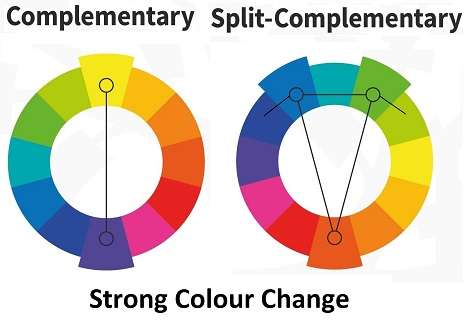
The subtle difference between the two, is the “Complementary” colour change model displays the two colours directly opposite each other on the colour wheel, whereas with the “Split-Complementary” colour change model we are looking for the change in colour to occur within two colour squares either side of the gemstones opposing colour, which again is the opposite colour from the gemstones base colour, as seen on the colour wheel.
The “Complementary” colour model is the rarest and hardest to find of the two colour models, but both are an indication of a strong degree of colour change strength and therefore represent a more valuable colour change combination in the gemstone.
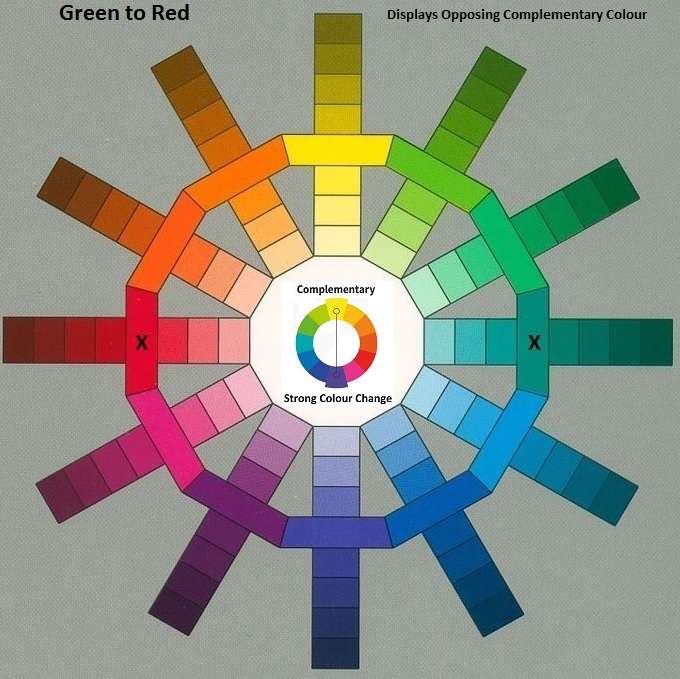
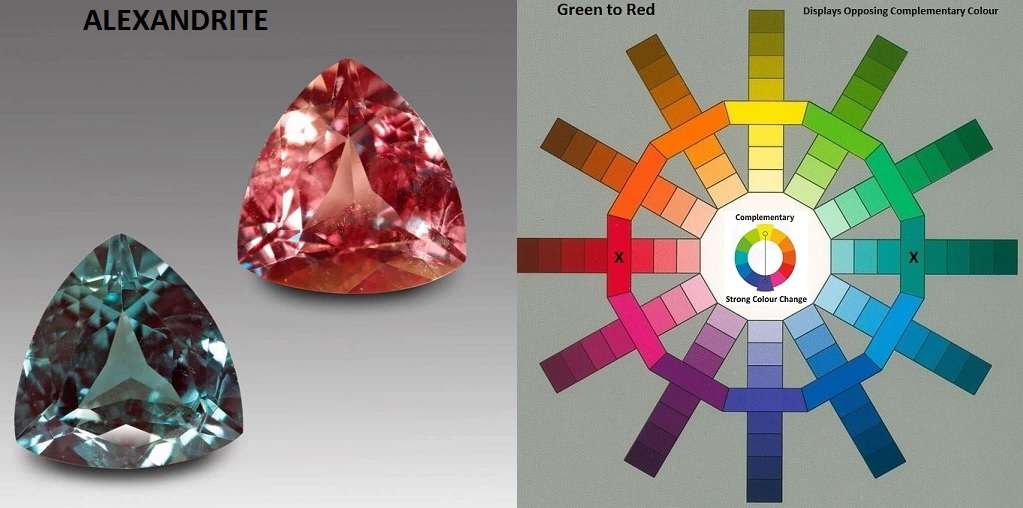
One of the best examples of a “Complementary” colour change is Alexandrite with a classic green to red colour change – Note how the green and red colours that I have marked with an “X”, appear at the opposite sides of the colour wheel creating the strongest colour change contrast.
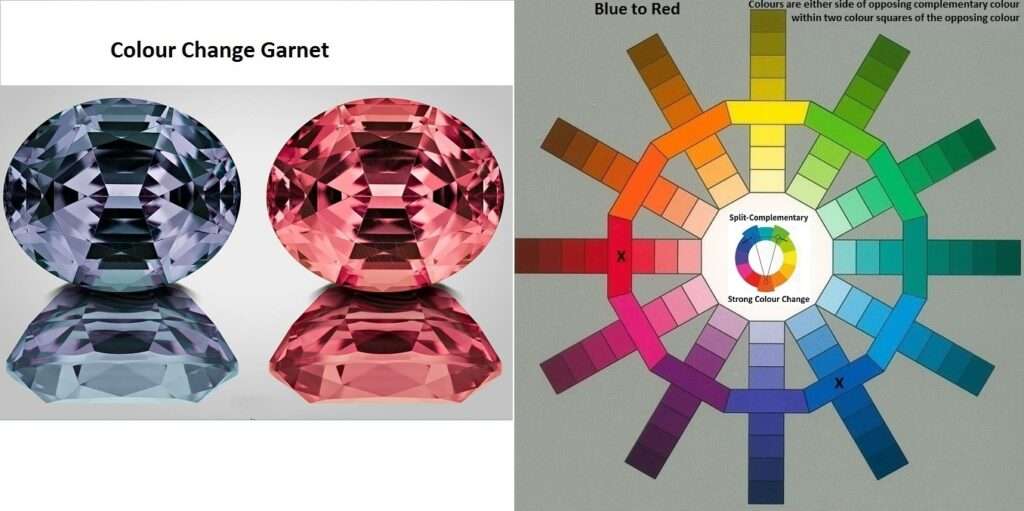
This very rare blue Garnet displaying a Blue to Red colour change, is a good example of a “Split-Complementary” colour change, with its opposing red colour occurring within two colour squares either side of blue’s opposing colour of orange.
While a Split-Complementary” colour change isn’t as rare as a “Complementary” colour change, it still indicates a strong colour change with this gemstone.
The next two colour change models I use to determine colour change strength are the “Square 90 Degree” and the “Analogous” models.
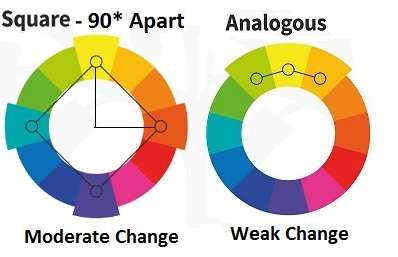
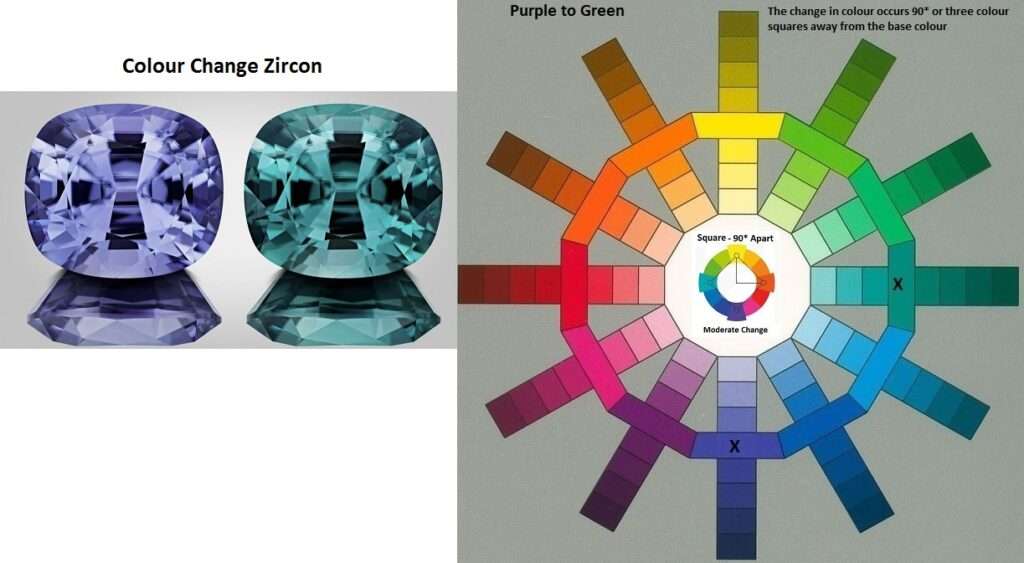
The “Square 90 Degree” colour change model occurs when the gemstones colour change colour is positioned 90 degrees or three colour squares away from the gemstones base colour on the colour wheel, and suggests a moderately strong colour change.
This purple to green colour change Zircon represents a good example of a “Square 90 Degree” colour change, with its colour change colour – green, occurring 90 degrees or three colour squares away from its base colour of purple on the colour wheel.
The “Analogous” colour change model is the weakest example of a colour change in gemstones and is what I would refer to as “Colour shift”.
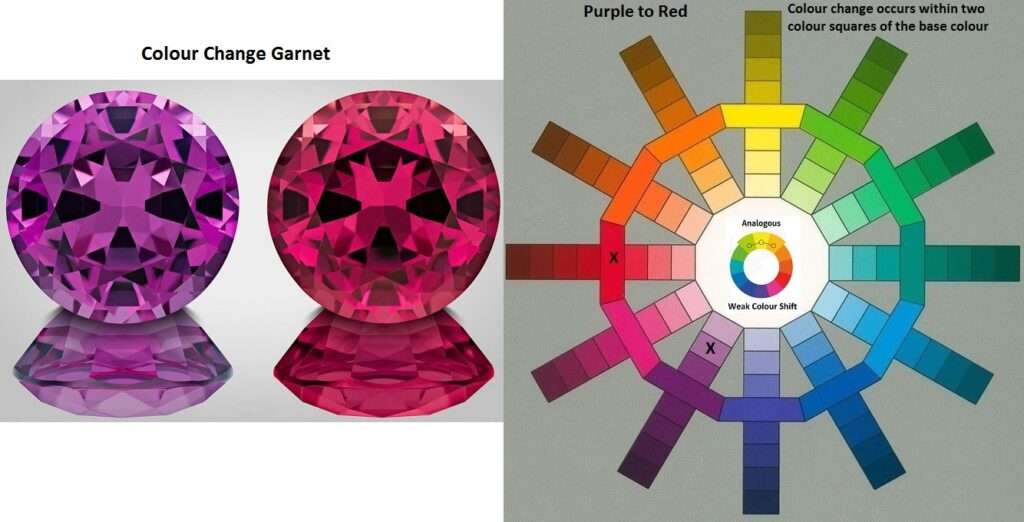
The change in colour occurs very close to and is within two colour squares of the underlying base colour of the gemstone, making its change in colour only a slight “shift” away from its underlying base colour on the colour wheel.
This purple maroon to red colour change Garnet is a well-known variety of colour change gemstone, but despite its popularity it scores the lowest degree of colour shift strength with our colour change models and is therefore categorised as an “Analogous” colour shift gemstone.
So to summarise the colour change strength indicated by our colour change models, you will find the strongest colour change occurs when the change in colour is seen on the opposite side of the colour wheel from the gemstones underlying base colour, the more colour squares the change in colour occurs away from the gemstones underlying base colour, the stronger the strength of the colour change will be.
The strongest “Complementary” colour change occurs the maximum distance of six colour squares away from the gemstones underlying base colour, with the second strongest “Split Complementary” colour change occurring four to five colour squares away from the gemstones underlying base colour.
A moderately strong “Square 90 degree” colour change occurs 3 colour squares away from the gemstones base colour, and the weakest “Analogous” colour shift occurs when the change in colour is within two colour squares away from the gemstones underlying base colour.
All colour change gemstones are a wonder of nature and worth collecting, but in terms of the rarity of colour change strength seen using these colour change models, my research suggests you will easily find twice as many of the weaker “Analogous” Colour Shift gemstones compared to the strongest colour change gemstones identified using the “Complementary” and “Split-Complementary” colour change models.
This makes gemstones with strongest colour change twice as valuable in terms of rarity, when compared to the more common and weaker colour shift gemstones.
Other Things to Consider Using Colour Theory:
Gemstones come in a complex array of colours which sometimes makes finding your gemstones underlying colours challenging on a 12 pointed colour wheel.
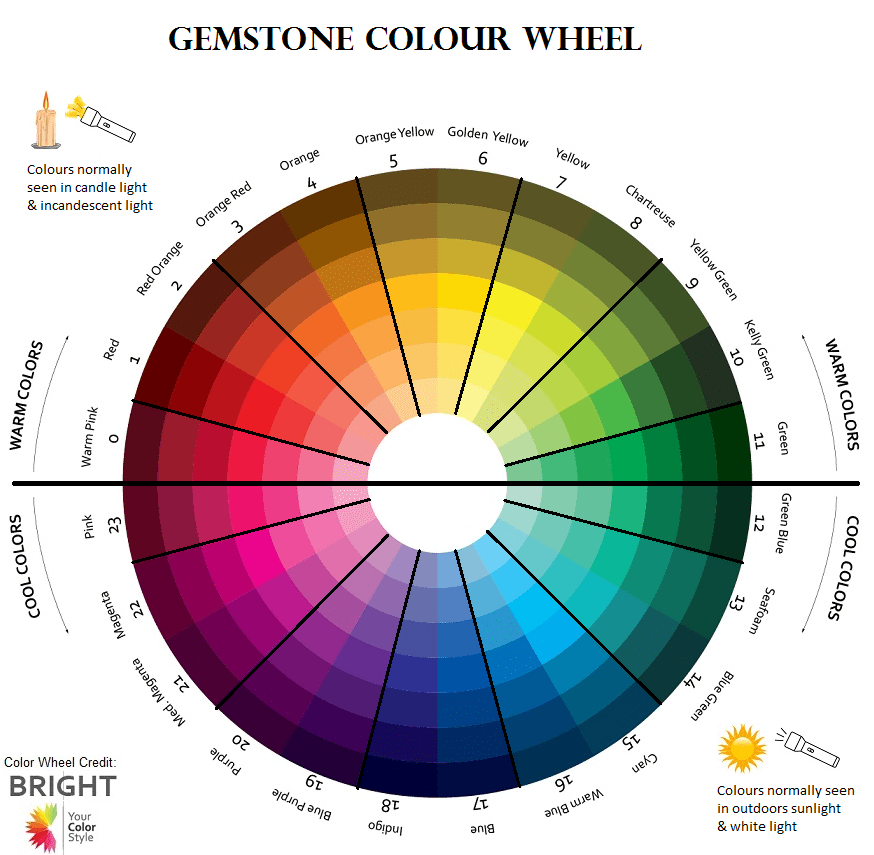
So an alternative “Vector” colour wheel can also be used, it has 24 individual colour segments with a great depth of colour variations in each colour segment to choose from, which may help you decide what colour segment your gemstones colour sits in.
I have also then divided it into another 12 individual colour “portions” using bold marker lines, so it matches up well with the previous colour wheels segments we have been using.
Also of interest in colour theory, is to understand what “Warm” and “Cool” colours are, which is defined by the line running through the middle of the colour wheel which separates the “Warm” and “Cool” sides of the colour wheel.
Separating warm and cool colours is a little more complex than one may think, as colour experts often differ on what they consider to be warm and cool colours.
If we look at the ‘Warm” and “Cool” division line that runs through this colour wheel, you can see that it runs through the middle of “Pink” on the left cardinal position and “Green” on the right cardinal position of the colour wheel.
As you can see the colour “Pink” sits on the cool side of the colour wheel while “Warm Pink” which is more of a “Reddish Pink”, sits on the warm side of the colour wheel, as the colour “Red” is considered a warm colour.
On the right side of the colour wheel you can see the colour ”Green” sits on the warm side of the colour wheel, as it has more yellow in its colour, the more yellow the greenish colours have, the warmer its colour is considered to be.
“Green Blue” on the other hand sits on the cool side of the colour wheel, as it has more “Blue” in it which is considered a cool colour.
I have also found its warm and cool colour division matches up well with the colour change gemstones I have compared it to.
With colour change gemstones, what we usually see displayed on our gemstones are “Cool” colours when the gemstone is exposed to an outside sunshine or a cool white light source and “Warm” colours when the gemstone is exposed to candle light or a warm incandescent light source.
If we now take another look at the purple to green colour change Zircon, you can see something quite remarkable about it when using colour theory.
This Zircon displays a purple violet colour when exposed to a cool white light source, which is to be expected as purple violet is one of the “Cool” colours on our colour wheel.
But what sets this gemstone apart from other colour change gemstones is the colour it displays under a warm incandescent light source – Green.
The colour green is considered a ”Cool” colour using the colour wheel, but in this case it is being displayed on the gemstone when exposed a “Warm” incandescent light source!
This is the complete reverse of what would normally be displayed on a colour change gemstone, as a warm incandescent light source will normally display ”warm” colours on the gemstone as per the “warm” colours shown on the colour wheel.
Very few colour change gemstones will display a “Warm” colour under a “Cool” light source or the reverse of this a “Warm” colour under a “Cool” light source.
This colour change phenomena is known as “Reverse Colour Change” and is very rare in colour change gemstones.
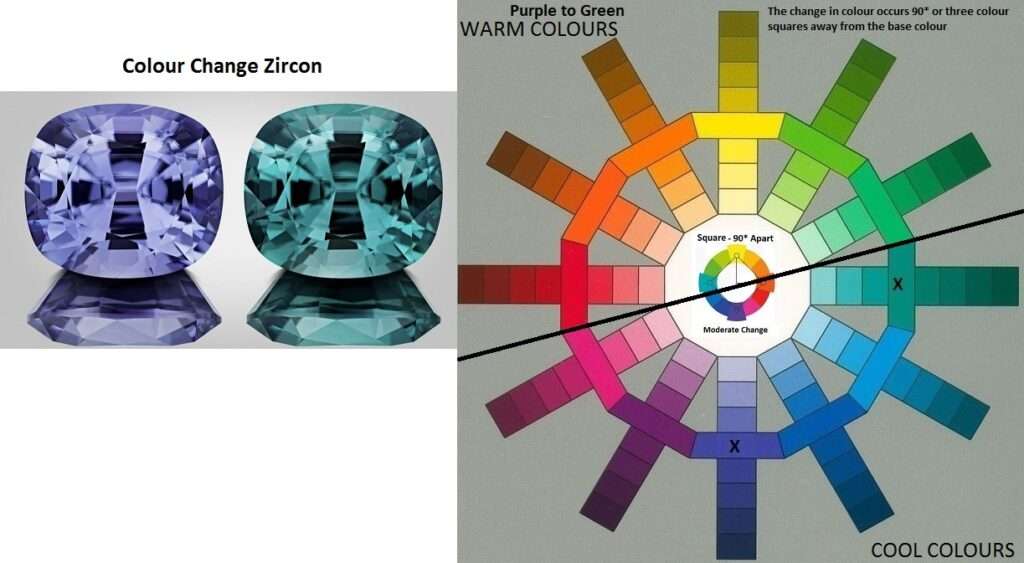
It’s this “reverse colour change” quality being displayed on this colour change Zircon that makes it quite remarkable and therefore a very rare and collectable gemstone, setting it apart from most other colour change gemstones for this reason.
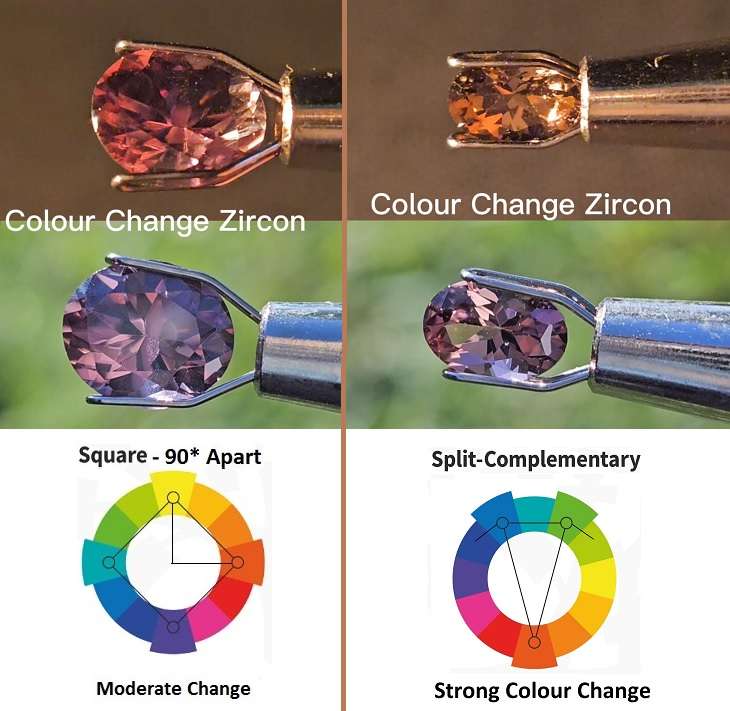
As another example of measuring colour change strength between gemstones, let’s now compare two colour change Zircons with the same underlying base colour of “Blue Purple” which is found in colour segment number 19 which sits at the bottom left on our newly expanded 24 segment colour wheel.
The Zircon on the left changes to “Red” when exposed to incandescent light and the Zircon on the right changes to a deep “Orange Red” colour when exposed to incandescent light.
The colour “Red” is found in colour segment number 1 on the left hand side, and the “Orange Red” colour is found just above that in colour segment number 3.
The difference this makes in terms of the colour change strength for each gemstones is significant, with the “Blue Purple” to “Red” colour change Zircon showing “Moderate” square 90 degree colour change strength, as its colour change to “Red”, occurs three colour portions away (shown with bold lines) in segment number 1 from its underlying base colour of “Blue Purple” in segment number 19.
While the “Blue Purple” to “Orange Red” colour change Zircon is displaying “Strong” Split complimentary colour change strength, as its colour change to ”Orange Red” occurs four colour portions away (shown with bold lines) in segment number 3 from its underlying base colour of “Blue Purple” in segment number 19.
This makes this gemstone more valuable as it has a “Stronger” colour change combination.
As an exercise see if you can plot these colours out on our newly expanded 24 segment colour wheel, using the 12 main segments shown with bold lines, to see if you can work out how these colour change strength categories were determined for these gemstones.
Understanding the degree of colour change strength found in colour change gemstones along with the rarity of the colour change and the different colour combinations you can find in them, can have a significant impact on their value and collect-ability.
The more knowledge you have about colour change gemstones, the better you will get as a collector of these amazing gemstones!
For those of you looking for more information on colour change gemstones, you can read a detailed article on Colour Change gemstones and to see more examples of them here:
I have been a collector these gemstones for many years and have a good variety of Colour Change gemstones available on the Gemrock Investments website that show both photos and videos of these amazing gemstones in action should you wish to consider any of them for your own collection.
You can review our list of current gemstones on offer here
General Disclaimer:
Any information provided by Gemrock Investments is for informational purposes only, and does not constitute financial advice, either general or specific. You should assess whether the information is appropriate to your individual financial circumstances before making an investment decision.
Gemrock Investments are not financial advisors. You should always seek professional financial advice from your accountant or financial planner before making major financial decisions.
The information provided has been derived from research and sources believed to be reliable. However, no guarantee is expressed or implied as to their validity. Opinions included herein are subject to change without notice.
All investments involve different degrees of risk and you should be aware of your risk tolerance level and your financial situation at all times.
The gem market is speculative and unregulated and certification does not eliminate all risks associated with the grading of gems.
It is also important to remember that previous growth and returns demonstrated from gemstone investments are not an indicator of future growth nor is it intended as an offer or solicitation with respect to the purchase or sale of any security or gemstone.
Gemrock Investments may also own gemstones in areas they feature or discuss.
Gemrock Investments urges you to obtain professional advice before proceeding with any gemstone investment decision.
